Crowned fork with a caliper brake: measuring the crown and positioning the brake hole
A crowned fork with a caliper brake comes down to three things: the crown dimensions, measured on the part itself with a measuring caliper; the offset, which results from the crown rake angle and the blade's own offset; and the brake hole. For a short-reach caliper (type 49) and a 700C rim, Shimano's table puts the bolt between 348.9 and 355.0 mm from the axle, depending on how far back the mounting face sits. That hole has to land inside the crown block: not above the crown race seat and not in the arch.
Crown dimensions: what to measure
ForkCAD treats the crown as a fixed block, described by what the builder measures on the part. The origin is the top face, which is the crown race seat. There is no preloaded crown library: you enter the dimensions of the crown you are using ("Custom" mode).
The names in the table are the labels ForkCAD's interface uses for each dimension.
| Letter | Name in ForkCAD | What it measures |
|---|---|---|
| A | Crown width (shoulders) | Shoulder to shoulder, front view (mm). Never larger than Se. |
| M | Height (top face → socket mouth) | From the top face to the socket mouth, where the blade goes in (mm). |
| Si | Inner spacing between sockets | Distance between the inner faces of the two sockets (mm). |
| Se | Outer spacing between sockets | Distance between the outer faces of the two sockets (mm). |
| Ca | Shoulder drop (from horizontal) | Shoulder angle from horizontal, from the race seat D out to A (°). |
| G | Top face → arch roof | From the top face to the roof of the arch (mm). |
| D | Steerer / race seat Ø | Crown race seat diameter (mm). |
| Ep | Socket wall thickness | Socket wall (mm). |
| P | Socket depth | Depth of the bore (mm). It does not change the crown shape. |
| B | Crown depth | Fore-aft size, side view (mm). |
| αc | Crown and blade rake angle | Tilts the whole crown from the top face, with no step, and the blade with it (°). |
| βc | Socket front angle | Tilts the bore inside the block, front view (°). It does not affect offset. |
What ForkCAD checks with these dimensions
With those inputs, ForkCAD checks that the blade fits into the socket, that the crown width does not exceed the sockets and that neither the shoulder nor a tilted bore breaks through the socket wall. If something does not fit, it marks the dimensions involved in red and, on mouse hover, explains why.
How offset (rake) results on a crowned fork
With the crown upright (αc = 0), the offset is the blade's own offset. In the panel this is "Blade own offset (socket at 0°)"; with a straight blade, it is the offset given by the dropout.
When the crown is raked forward by αc, the blade tilts with it from the top face and the socket mouth moves forward by M·tan αc. The resulting offset is:
R = L·tan αc + own offset / cos αc
- L is the length parallel to the steerer, from the crown race seat to the axle. If you work with direct axle-to-crown AC, L = √(AC² − R²).
- L·tan αc is how far the axle moves forward when the whole assembly is tilted.
- own offset / cos αc is the blade's offset referred to the steerer once the blade is tilted.
βc is not in the formula: it tilts the bore in the front view, inside the block, and leaves R unchanged. ForkCAD reports the result as "Resulting offset R". With that offset and the head angle you get trail, as covered in the fork trail and offset calculator.
Caliper brake hole position on the fork
Bolt, recessed hole and reach
| Item | Value | Source |
|---|---|---|
| Centre bolt | M6 | Sheldon Brown |
| Hole for recessed mounting | 6 mm front, 8 mm rear | Sheldon Brown |
| Nutted mounting | Through bolt and 10 mm hex nut | Sheldon Brown |
| Short reach | 39–49 mm | Sheldon Brown |
| Long reach | 47–57 mm | Sheldon Brown |
Sheldon Brown warns that "short", "normal" and "long" have meant different ranges over time. The range in millimetres is what to go by.
Hole position table: type 49 caliper, 700C rim
The table in circulation is Shimano's; today it is found in Peter Verdone's reproduction. Its dimensions are:
- A: offset of the mounting face from the axle.
- B: axle to bolt, parallel to the mounting face. Tolerance +3 / −1 mm.
- C: direct distance from axle to bolt.
| A (mm) | −30 | −20 | −10 | 0 | 10 | 20 | 30 | 40 | 50 |
|---|---|---|---|---|---|---|---|---|---|
| B (mm) | 348.9 | 350.7 | 352.3 | 353.4 | 354.3 | 354.8 | 355.0 | 354.9 | 354.4 |
| C (mm) | 350.2 | 351.3 | 352.4 | 353.4 | 354.4 | 355.4 | 356.3 | 357.1 | 357.9 |
Corrections for other rims and calipers
Shimano gives these corrections to the table above:
| Caliper and rim | Correction (mm) |
|---|---|
| Type 49 + 650C (BSD 571) | −27.6 |
| Type 57 + 700C | +8.0 |
| Type 57 + 650C | −17.6 |
Verdone points out a flaw in this approach: B and C cannot take the same offset, because the two dimensions do not change by the same amount.
Verdone's formula and 650B rims
B = 43 + √((BSD/2 + 1)² − (X + 31.2 + washer)²)
C = √(B² + X²)
- BSD: rim bead seat diameter (622 for 700C).
- washer: washer thickness. Verdone assumes Shimano's values do not include it.
- X: mounting face offset with Verdone's sign, which he flipped from A. With BSD 622, washer 0 and X = −A, the formula returns the table values; with A = 0, B = 353.4 mm.
Shimano's table does not cover 650B. With BSD 584 and A = 0, Verdone's formula gives B = 334.3 mm.
The brake hole in ForkCAD
In ForkCAD you choose a short-reach (type 49) or long-reach (type 57, +8 mm) caliper and the program gives you three results: "Axle → caliper hole (B)", "Mounting face behind the axle (A)" and "Race seat → caliper hole", which is the drilling height.
If the hole is too close to the crown race seat or the arch, ForkCAD marks AC or L in red and tells you which length fixes it: if it moves up towards the race seat, the fork is too short for that caliper; if it falls in the arch, it is too long. How L and AC relate is covered in fork axle-to-crown length.
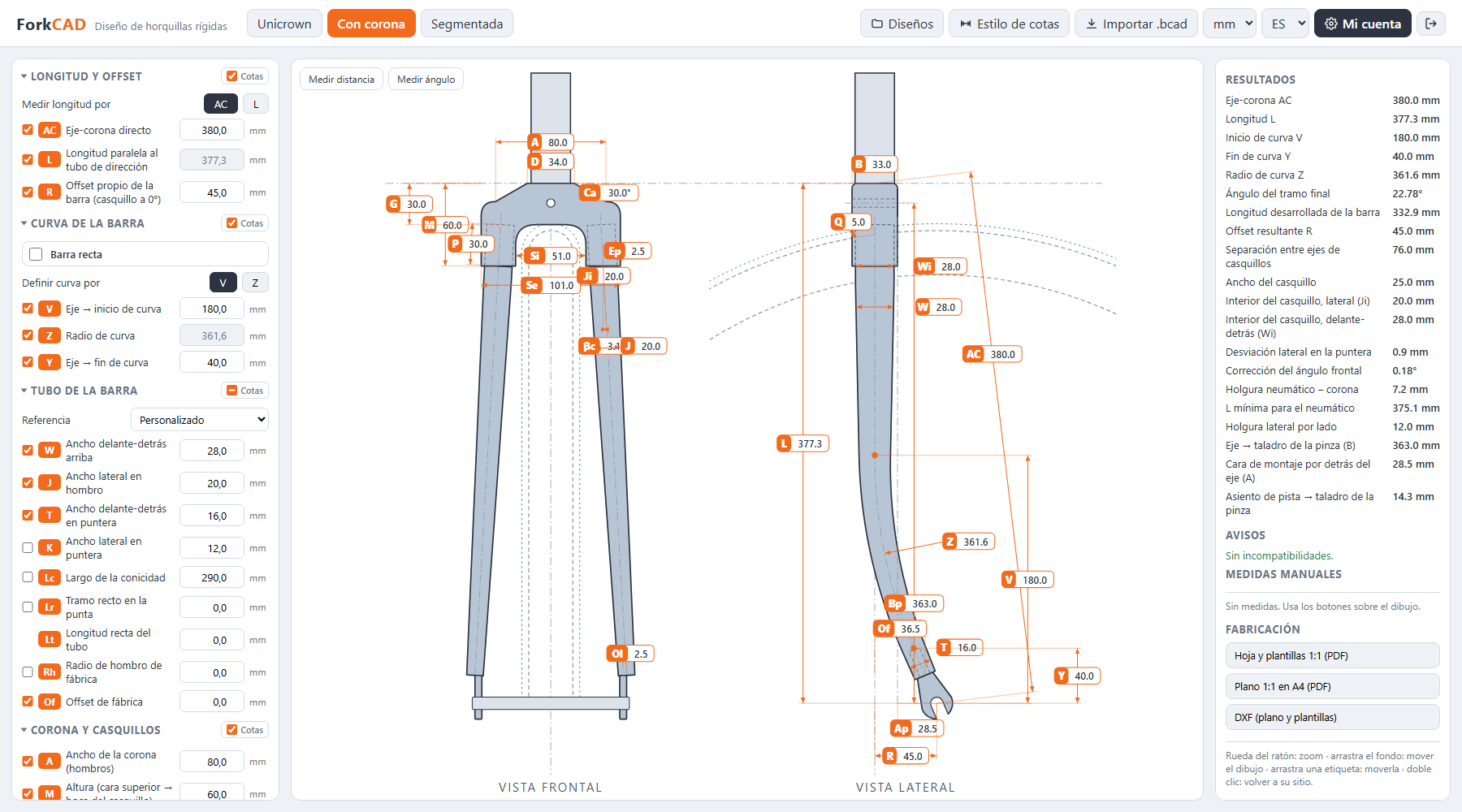
What ForkCAD gives you to build a crowned fork
- Blade cut length: insertion into the socket, developed length and dropout.
- Lateral deviation at the dropout, in mm and degrees, with no automatic adjustment.
- Steerer cut length.
- Wheel clearance.
- 1:1 plan in PDF and DXF, plus developed miter templates.
If the fork takes cantilever or V-brakes instead of a caliper, the bosses follow a different Shimano standard: see fork V-brake and cantilever bosses.
FAQ
How far from the axle is the caliper brake hole on a 700C fork?
For a type 49 caliper, Shimano's table gives B between 348.9 and 355.0 mm depending on the mounting face offset A; with A = 0, 353.4 mm. For a type 57 caliper, add 8.0 mm.
What size is the hole for a recessed caliper brake?
6 mm on the front face and 8 mm on the rear, for an M6 bolt (Sheldon Brown).
Does Shimano's table work for 650B?
It does not cover 650B. Verdone's formula, which is not official, gives B = 334.3 mm for BSD 584 with A = 0.
Does the socket front angle change the offset?
No. βc tilts the bore inside the crown in the front view; offset depends on αc, L and the blade's own offset.
Sources
- Sheldon Brown: caliper brakes: centre bolt, recessed hole, nutted mounting and reach ranges.
- Peter Verdone: caliper rim brake locations: Shimano table for type 49 and 700C, corrections and formula.