Unicrown vs crowned vs segmented fork: the types of rigid fork compared
There are three types of rigid fork, defined by how the blades join the steerer. On a unicrown fork, the blades bend at the shoulder and join the steerer directly. On a crowned fork, they go into the sockets of an existing crown. On a segmented fork, tube arms run from the steerer to the blades. Choosing unicrown vs crowned, or going segmented, changes which parts you buy, which dimensions you measure and what you have to fabricate.
The three types side by side
| Unicrown | Crowned | Segmented | |
|---|---|---|---|
| How the blade joins | Bends at the shoulder and joins the steerer | Goes into the crown socket | A tube arm joins it to the steerer |
| Type-specific parts | Blades bent at the shoulder, steerer | Crown, blades | Arms, capped blades, steerer |
| What the builder decides | Shoulder (A, E, J, G) and blade bend (V or Z, plus Y) | Which crown to use; its dimensions are measured with calipers | Height, spacing S, drop δ and swing θ of the arms |
| Blade angles | Set by the blade bend | Set by the crown (αc and βc) | A result of the arms |
| Joints | Blade-to-steerer mitering | Blade inserted into the socket | Compound miters, arm to steerer and arm to blade |
| Build measurements | Developed length, bend dimensions, shoulder radius | Cut length (insertion + developed + dropout), resulting offset, lateral deviation at the dropout, steerer cut length | Arm length Lb, blade angles α and β, cut lengths |
| Top clearance | Under the arch and steerer | Under the crown | Under the arms |
All three have a steerer and dropouts. With a fender, all three are also checked for the side gap between the blades. In ForkCAD, brakes, dropouts, mounts and fenders work the same way in all three types.
Unicrown: the shoulder and the blade bend
A unicrown has no crown: the blade itself forms the shoulder. In the front view you set A (outer width at shoulders), E (shoulder height), J (lateral width at shoulder) and G. In the side view, the length (L or AC), the offset R and the three-section blade bend, with V or Z, plus Y.
The key build decision is the shoulder. If the blade comes bent from the factory, its radius fixes dimension E. For Columbus unicrown blades, the factory radius shown on a drawing is R80, on FBRN16U410DSK and FBRN16U410DSK001; for the others, Columbus does not give the radius on its drawings. If you bend the shoulder yourself, the radius is an output.
What you fabricate: the developed length of each blade, the bend dimensions, the shoulder radius and the blade-to-steerer mitering. Every dimension, step by step, in unicrown fork design.
Crowned fork: you measure the crown
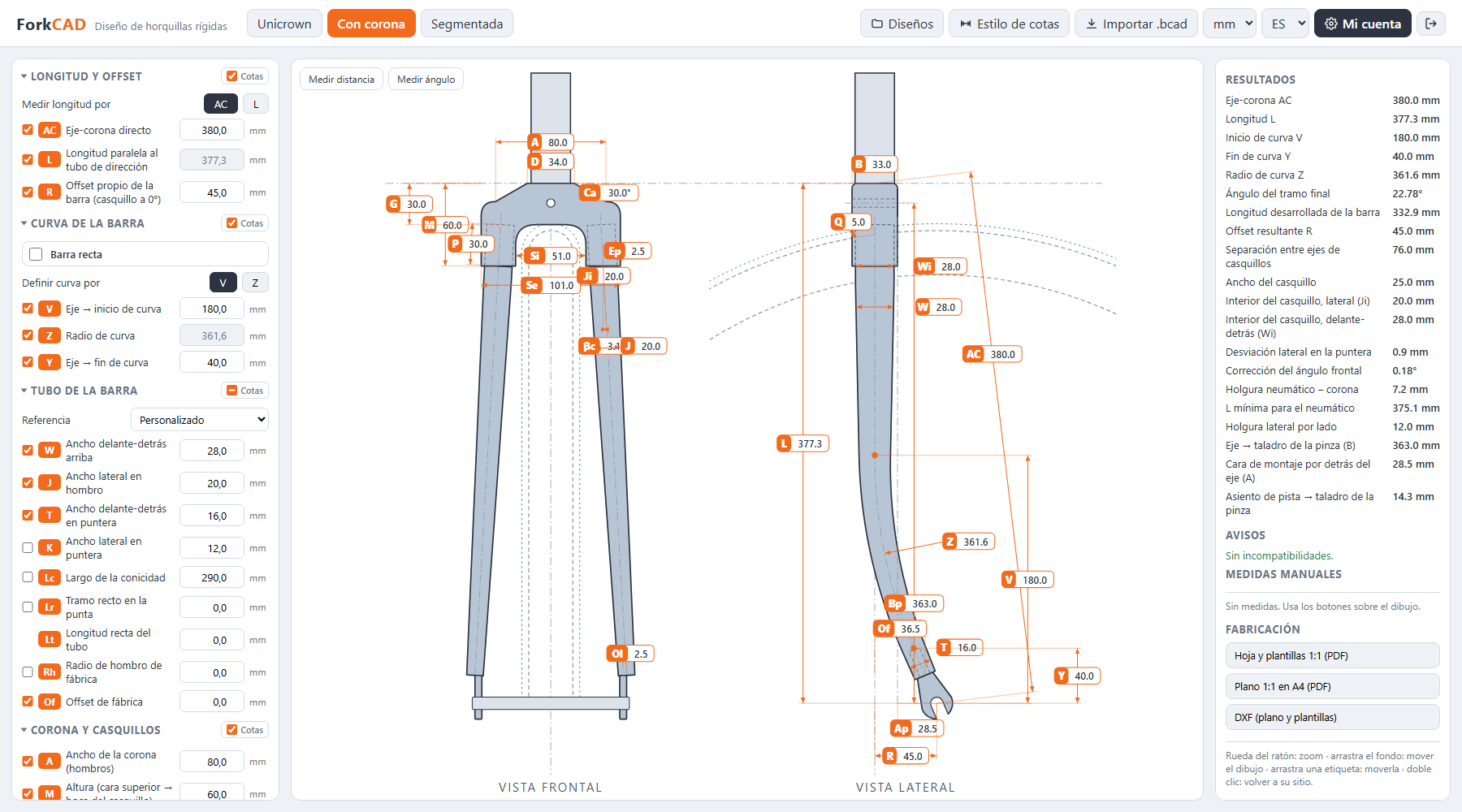
The crown is a fixed block: you do not design it in ForkCAD. The builder's job is to measure the crown they will use with calipers and enter those numbers. ForkCAD has no crown library: crowns are entered in “Custom” mode, with the origin at the top face (the crown race seat).
| Dimension | What it measures |
|---|---|
| A | Crown width (shoulders); never larger than Se |
| M | Height (top face → socket mouth) |
| Si / Se | Inner / outer spacing between sockets |
| Ca | Shoulder drop (from horizontal) |
| G | Top face → arch roof |
| D | Crown race seat Ø |
| Ep | Socket wall thickness |
| P | Socket depth |
| B | Crown depth (side view) |
| αc | Crown and blade rake angle |
| βc | Socket front angle |
The blade has to fit into the socket, both laterally (J) and fore-aft (W). ForkCAD checks this with those dimensions and, if it does not go in, marks the ones involved in red.
How the crown sets the offset
αc tilts the whole crown from the top face, and the blade with it: the socket mouth moves forward by M·tan αc and the offset becomes R = L·tan αc + blade own offset / cos αc. βc tilts the bore inside the block and does not affect R, but it can push the blade sideways: ForkCAD reports that deviation at the dropout in mm and degrees, without correcting it on its own.
Rim caliper brake on the crown
With a rim caliper, the hole goes in the crown. For recessed mounting it is stepped: 6 mm at the front and 8 mm at the back. ForkCAD checks that it lands inside the crown, without getting too close to the crown race seat or the arch. More in crowned fork with a caliper brake.
Segmented fork: arms with a fixed S
On a segmented fork, each blade joins the steerer through a tube arm. The blade angles are not entered: they result from how you place the arms. The inputs are:
- Hb (Race seat → arm axis): arm height on the steerer, which acts as the pivot.
- S (Blade spacing at junction): fixed.
- δ (Arm front angle, drop).
- θ (Arm forward swing), in the top view, pivoting on the steerer.
- Øb (Arm Ø), round or oval.
- Pr (Blade extension above junction), closed with a cap.
- Plus D, J, W and T, as on the other types.
The rule: when θ swings, S stays the same and the arm gets longer: Lb = (S/2)/cos θ, and the junction moves forward by X = (S/2)·tan θ. The arm axis meets the blade axis. When θ changes, ForkCAD updates the arm length automatically.
What you fabricate: the arms with their cut length, the compound miters arm to steerer and arm to blade, and the blades with their angles α and β. Wheel clearance is checked under the arms. The full build is in segmented fork design.
What to check before choosing a type
- Do you have a crown for that blade? On a crowned fork the blade has to fit the socket (laterally and fore-aft) and width A cannot exceed Se. Without a crown that fits, you are left with unicrown or segmented.
- Factory-bent blade or your own bend? On a unicrown, a factory shoulder radius fixes E. Make sure the manufacturer's drawing gives the radius.
- Do you want to set the blade angles or let them follow? On a unicrown the bend sets them; on a crowned fork, αc and βc; on a segmented fork they result from Hb, S, δ and θ.
- Which joints will you cut? Unicrown: one miter per blade against the steerer. Segmented: two compound miters per arm. Crowned: the blade is inserted into the socket.
- Will it take a fender? The fender has to clear the crown, the steerer or the arms depending on the type. ForkCAD warns you if it is tight and gives you the minimum L with a fender.
FAQ
What is the difference between a unicrown and a crowned fork?
On a unicrown, the blades bend at the shoulder and join the steerer; there is no crown. On a crowned fork, the blades go into the sockets of a crown, which is a fixed block.
What is a segmented fork?
A fork without a crown where each blade joins the steerer through a tube arm. The blade spacing at the junction (S) is fixed and the blade angles follow from the arm position.
How do you enter a crown that is not in any library?
By measuring it with calipers: A, M, Si, Se, Ca, G, D, Ep, P and βc in the front view, and B and αc in the side view. ForkCAD has no preloaded crowns: they are all entered this way.
If I swing the arms on a segmented fork, does the blade spacing change?
No. S stays the same and the arm gets longer: Lb = (S/2)/cos θ. The junction moves forward by X = (S/2)·tan θ.
Sources
- Sheldon Brown, Installing and Adjusting Caliper Brakes (stepped hole for recessed mounting: 6 mm at the front, 8 mm at the back).
- Columbus, drawing of the FBRN16U410DSK and FBRN16U410DSK001 blades (factory bend radius R80). Manufacturer documentation, no public link.