Segmented fork design: arm dimensions, blade angles and compound miters
A segmented fork joins each blade to the steerer with a tube arm, with no crown. You do not choose the blade angle: you set the arm height, its drop, its forward swing and the blade spacing at the junction, and the blade angles come out as a result. The key rule is that spacing S stays fixed when the arm swings forward, so the arm gets longer: Lb = (S/2)/cos θ.
How a segmented fork is defined
Each arm starts at a pivot on the steerer axis, at height Hb below the crown race seat. From there it runs out to the blade at two angles: δ, the drop in the front view, and θ, the forward swing in the top view. The arm ends where its axis crosses the blade axis: that point is the junction.
The blade runs from the junction to the dropout. Since both ends are fixed by other dimensions, its angles are an output, not an input. That is the basic difference from a unicrown or a crowned fork, where the shoulder or the socket sets the blade direction.
Segmented fork inputs
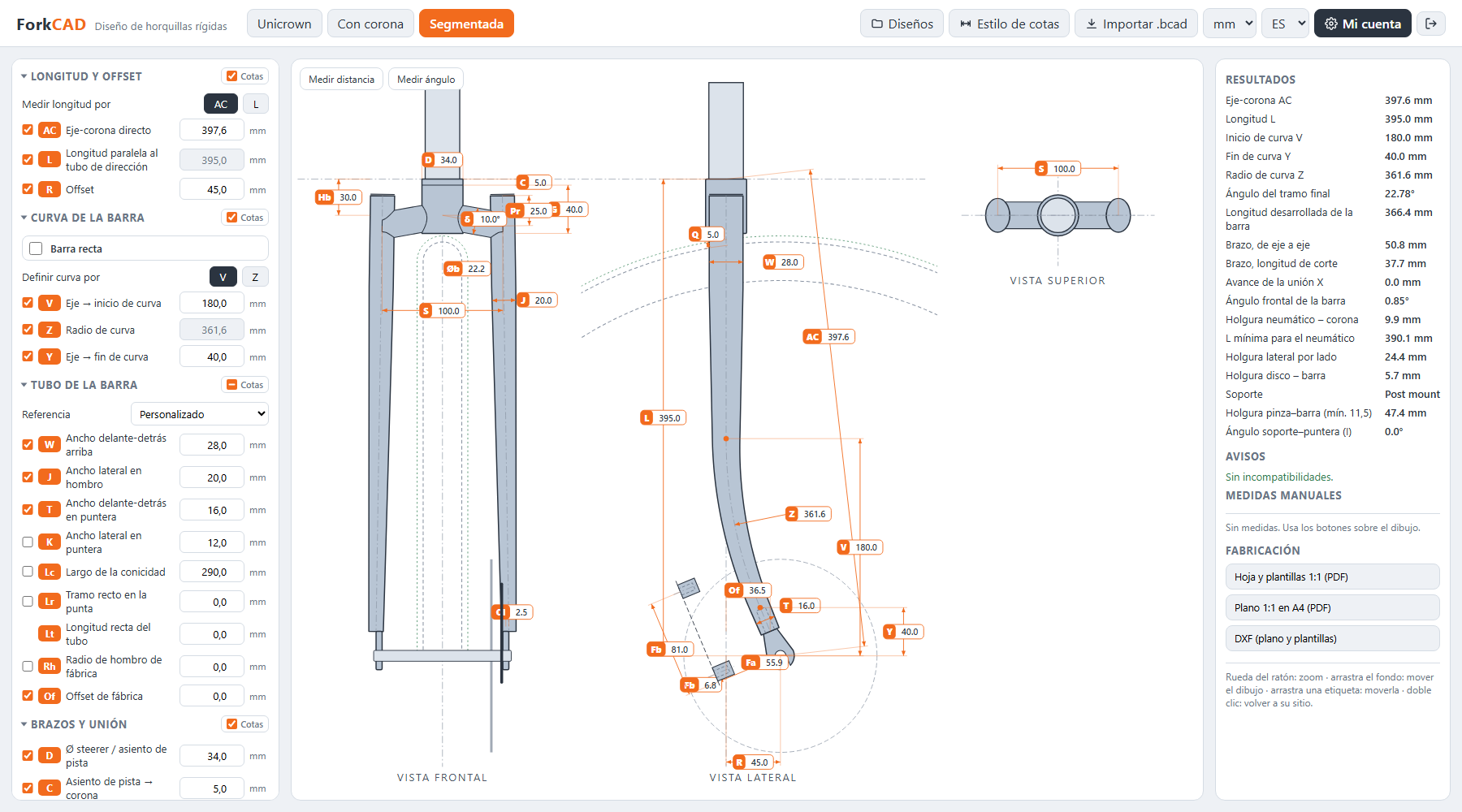
On top of the inputs shared by every fork (L or AC, offset R, wheel, hub and axle), a segmented fork is defined by these dimensions. The names are the labels used in ForkCAD's interface.
| Letter | Name in ForkCAD | What it is |
|---|---|---|
| D | Steerer / race seat Ø | Steerer diameter at the crown race seat (mm). |
| Hb | Race seat → arm axis | Height of the arm pivot, on the steerer axis (mm). |
| S | Blade spacing at junction | Distance between the two blade axes at the junction (mm). It is fixed. |
| δ | Arm front angle (drop) | Arm angle in the front view (°). |
| θ | Arm forward swing | Swing in the top view, pivoting on the steerer (°). |
| Øb | Arm Ø | Arm tube diameter (mm). |
| Pr | Blade extension above junction | How far the blade continues above the junction, closed with a cap (mm). |
| J | Lateral width at shoulder | Blade section, lateral (mm). |
| W | Fore-aft width at top | Blade section, fore-aft, at the top (mm). |
| T | Fore-aft width at dropout | Blade section, fore-aft, at the dropout (mm). |
Tube sections (blade and arm) are measured square to the tube axis.
Arm length: Lb and X as θ changes
When the arm swings forward, S does not change. To keep the blade spacing, the arm gets longer and the junction moves forward:
Lb = (S/2) / cos θ
X = (S/2) · tan θ
- Lb: arm length. In ForkCAD, "Arm, axis to axis".
- X: junction advance. In ForkCAD, "Junction advance X".
At θ = 0 the arm is S/2 long and X is 0. Both grow as θ grows. That is why X is a calculated value: you choose θ and the advance follows.
In ForkCAD, arm length updates automatically when θ changes.
Blade angles are an output
With the junction placed by Hb, δ, θ and S, and the dropout placed by L, R and hub width, the blade is fully defined. ForkCAD reports its two angles:
- α, the blade angle in the side view ("Blade angle" with a straight blade; "Lower section angle" with a bent blade).
- β, the angle in the front view ("Blade front angle").
To change a blade angle, move the junction (Hb, δ, θ or S) or the dropout (L or R). ForkCAD redraws the design and recalculates the angles in real time with every change.
Compound miters: arm to steerer and arm to blade
The arm meets the steerer and the blade tilted in two views at once (δ in front, θ on top), so both miters are compound. ForkCAD generates both developed templates:
- "Template: arm – steerer": wrap it around the steerer end of the arm, base towards the blade, and line up the "front" mark with the front of the arm.
- "Template: arm – blade": wrap it around the blade end of the arm, base towards the steerer, and line up the "front" mark the same way.
Cut lengths and wheel clearance under the arms
To build a segmented fork, ForkCAD gives you:
- Lb, axis to axis, and the arm cut length ("Arm, cut length").
- Blade cut lengths.
- A 1:1 plan in PDF and DXF with the miter templates.
- Wheel clearance under the arms.
If the fork takes a fender, ForkCAD also checks its clearance under the arms and between the blades, and warns you if it is tight. How each clearance is measured is explained in fork tyre and fender clearance.
If you are still choosing a fork type, the comparison is in unicrown vs crowned vs segmented fork.
FAQ
What is the difference between a segmented fork and a crowned fork?
On a crowned fork, the blade goes into a socket in a solid block and the crown sets its direction. On a segmented fork, tube arms join the steerer to the blades, and the blade angles follow from where the junction sits.
Why does the arm get longer when it swings forward?
Because blade spacing S at the junction is fixed. When θ changes, the arm becomes (S/2)/cos θ long and the junction moves forward by (S/2)·tan θ.
What is the blade extension Pr for?
It is the length of blade left above the junction with the arm. It is closed with a cap.
How are blade and arm sections measured?
Square to each tube's axis.