Fork tyre clearance: crown, blades, fender and rotor
Tyre clearance on a rigid fork comes down to five checks: under the crown (or under the steerer, or under the arms of a segmented fork), between the blades at tyre height, at the side gap where the fender crosses the blades, between the rotor and the blade, and the length L, which sets how high the crown sits above the axle. At each point you measure the free distance with the tyre mounted and inflated, and with the fender if the bike will have one.
This guide covers what to measure at each point and how. It does not give "recommended" clearances for mud or per tyre type: neither the standards nor the manufacturers cited here give a figure, and that call belongs to the builder.
Tyre size: ISO 5775 / ETRTO
The ISO tyre size (formerly the ETRTO system, from the European Tyre and Rim Technical Organisation) is two numbers in millimetres: width-BSD. On a 45-622, 45 is the inflated tyre width and 622 is the BSD (bead seat diameter) of the rim. The current standard is ISO 5775-1:2023, Bicycle tyres and rims – Tyre designations and dimensions.
| BSD (mm) | Common name |
|---|---|
| 622 | 700C |
| 584 | 650B |
| 559 | 26" (26 × 1.00–2.125; also fatbike up to 5") |
Actual width varies a little with rim width, as Sheldon Brown points out. To check clearance, measure the tyre mounted and inflated on the rim the bike will use, not the number on the sidewall.
The five clearance checks on a rigid fork
| Check | What you measure | ForkCAD result |
|---|---|---|
| Under the crown, steerer or arms | From the top of the tyre (or fender) to the lowest point of the crown | Tyre – crown clearance; Fender – crown clearance |
| Between the blades | Inside spacing between blades minus tyre width, per side | Lateral clearance per side |
| Fender crossing | Inside spacing between blades at that height minus the fender profile width at that height | Side gap with fender (per side) |
| Rotor – blade | From the rotor plane to the inner face of the disc-side blade | Rotor – blade clearance |
| Length L | The shortest L at which the fender clears the crown | Minimum L with fender |
1. Clearance under the crown, steerer or arms
This is the vertical free space between the top of the tyre and the lowest point of whatever sits above it. That part depends on the fork type:
- Unicrown: the arch under the shoulders and the bottom of the steerer. In ForkCAD that is G, "Crown → steerer bottom".
- Crowned: the roof of the crown arch. In ForkCAD that is the crown's G, "Top face → arch roof", measured from the crown race seat.
- Segmented: the arms that run from the head tube to the blades. Clearance is checked under them.
Measure it in the wheel's centre plane, where the tyre reaches highest. With a fender, the reference is no longer the tyre but the outer face of the fender.
2. Clearance between the blades at tyre height
Measure at the height where the tyre is widest: inside spacing between the two blades minus the actual tyre width, split between both sides. If the wheel is not centred in the fork, the tighter side is the one that counts. How close each blade comes to the tyre depends on the shoulder width A, the lateral blade width J and the hub width.
3. Fork fender clearance where the fender crosses the blades
The fender wraps around the tyre and, in side view, crosses the blades at a given height. At that height the blades have a given inside spacing, and the fender has a given width. Because the profile is curved, its width at the crossing height is not necessarily its full width. The side gap is the inside spacing at that height minus the profile width at that same height, divided by two.
4. Rotor to blade clearance
The rotor spins in a plane parallel to the dropout, a short distance inboard of it, and the disc-side blade has to stay clear of that plane over the whole height the rotor sweeps (its diameter). Measure perpendicular to the rotor plane, from the rotor to the inner face of the blade. Where that plane sits is covered below. Caliper interference is a separate check that depends on the mount: see the guide to fork disc brake mounts.
5. Minimum L with a fender
L is the length parallel to the head tube, measured from the face of the crown race seat. With R fixed, a longer L raises the crown relative to the axle and adds clearance; a shorter L takes it away. With a fender, the crown has to clear the tyre, the tyre-to-fender gap and the fender thickness. The shortest L that does so is the minimum L with fender. How L, axle-to-crown and offset relate is explained in the guide to fork axle-to-crown length.
The fender and the rotor in ForkCAD
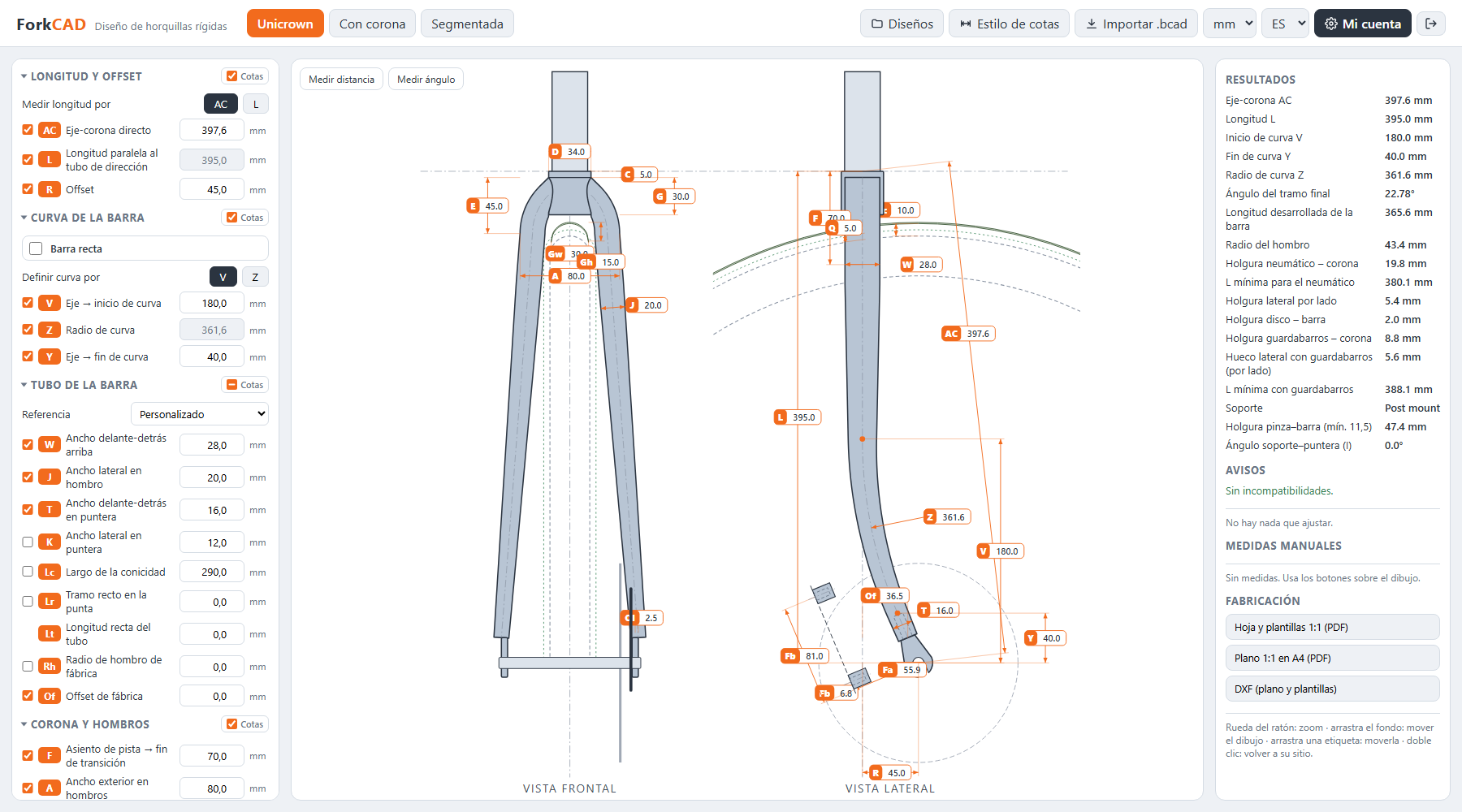
Fender: Gc, Gt, Gh and Gw
The fender is switched on with the "Will take a fender" checkbox and described with four dimensions only:
| Dimension | Meaning |
|---|---|
| Gc | Tyre-to-fender gap: radial distance from the tyre to the inner face of the fender (mm) |
| Gt | Fender thickness (mm) |
| Gh | Profile height: height of the section (mm) |
| Gw | Fender width: width of the section (mm) |
With these dimensions, ForkCAD runs two checks: clearance under the crown, steerer or arms, and the side gap between the blades where the fender crosses them, using the actual profile width at that height. It also shows the minimum L with fender.
Measure Gh and Gw on the fender you will fit. Gc is the gap you want between tyre and fender: that one is your decision.
Rotor: a plane about 9.5 mm inboard of the dropout
You pick the rotor size and ForkCAD draws it in its plane, about 9.5 mm inboard of the dropout face. That figure comes from two SRAM values:
| Value | mm | Source |
|---|---|---|
| Rotor mounting face on an ISO 6-bolt hub, from the dropout face | 10.5 ±0.3 | SRAM Road Frame Fit 2024, p. 120 |
| Rotor thickness | 1.85–2.0 | SRAM MTB Frame Fit 2024 |
| Rotor centre plane, inboard of the dropout face | ≈ 9.5 | From the two values above |
For 110 mm Boost hubs, SRAM does not give that figure: if you fit one, check it against the hub.
If any of these clearances is tight, ForkCAD marks the dimension in red and warns you, but it does not change your values. For how A, J and E shape a unicrown, read the guide to unicrown fork design.
FAQ
What does 45-622 mean on a tyre?
It is the ISO 5775 size (formerly ETRTO): 45 mm inflated tyre width and 622 mm BSD, the bead seat diameter of the rim. 622 is the rim known as 700C.
How much mud clearance should a fork have?
Neither the standards nor the manufacturers cited here give a figure: it is your decision. In ForkCAD you set the tyre-to-fender gap (Gc), and the program checks that everything clears with it.
How far from the dropout is the rotor?
The rotor mounting face on an ISO 6-bolt hub sits 10.5 ±0.3 mm from the dropout face (SRAM). With a 1.85–2.0 mm rotor, its centre plane ends up about 9.5 mm inboard.
What fender mounts can I fit?
ForkCAD has three types: barrel boss, inserted boss and dropout boss. You can place them wherever you want, and the program warns you if two on the same face are too close together.
Sources
- ISO 5775-1:2023, Bicycle tyres and rims – Tyre designations and dimensions (BSI listing)
- Sheldon Brown, Tire Sizing Systems
- SRAM 2024 Road Frame Fit Specifications (p. 120, hub)
- SRAM 2024 MTB Frame Fit Specifications
- Shimano, Disc brake – Front/Rear disc brake mount dimensions, Ver. 1.3 (copy hosted by Peter Verdone)