Suspension-corrected rigid fork: how to work out the axle-to-crown
To fit a rigid fork to a frame designed around a suspension fork, start from the axle-to-crown and offset of the suspension fork the frame was designed for, then subtract the sag (how far the fork compresses under the rider). In a framebuilders’ thread on the Velocipede Salon forum, the figure that comes up most is 20% of the travel: with a 100 mm fork, the rigid fork comes out about 20 mm shorter. That is what a suspension-corrected fork is.
What a suspension-corrected fork is
A mountain bike frame with a suspension fork is designed so the geometry is right when the fork is working, not when it is fully extended. A rigid fork does not compress, so to keep the frame where it would sit with the suspension fork in use, it has to be shorter than the extended suspension fork.
As one builder put it on Velocipede Salon, the frame is designed around the fork in its sagged position, because that is where the neutral point is while riding. A suspension-corrected rigid fork reproduces that position.
Where the starting axle-to-crown comes from
The starting figure is the axle-to-crown (and offset) published by the maker of the suspension fork the frame came with or was designed for. Two cautions:
- Check how it is measured. Axle-to-crown can be given as a straight line (AC) or parallel to the head tube (L). They are linked by the offset R: L = √(AC² − R²). The difference is explained in fork axle-to-crown length.
- Do not assume a figure from the travel. According to a builder in the same thread, 100 mm forks vary between 470 and 480 mm axle-to-crown, even across models from the same brand. Look up the spec sheet for the exact model.
How much sag to subtract
There is no standard; this is shop practice. This is what several builders said in the Velocipede Salon thread on this topic:
- The figure that comes up most is 20% of the travel, unless the rider asks for something else.
- Some use 25% or 30%, depending on the rider and how soft they run the suspension.
- One of them recommends a higher sag percentage as travel increases.
The table shows how much to subtract at each percentage. It is just arithmetic; the percentage is your call.
| Travel (mm) | Sag at 20% (mm) | Sag at 25% (mm) | Sag at 30% (mm) |
|---|---|---|---|
| 80 | 16 | 20 | 24 |
| 100 | 20 | 25 | 30 |
| 120 | 24 | 30 | 36 |
Worked example
With example figures, not a real model: a 100 mm travel fork with a published axle-to-crown of 480 mm.
- Sag at 20%: 100 × 0.20 = 20 mm.
- Rigid fork axle-to-crown: 480 − 20 = 460 mm, measured the same way as the starting figure (AC or L).
- Offset: that of the suspension fork, if you want to keep its steering geometry.
Which offset to give the rigid fork
With the same corrected axle-to-crown, the same offset and the same wheel, the steering ends up as it was with the suspension fork at sag: same head angle, same trail. Change the offset and you change the trail. You can see by how much in the fork trail and offset calculator.
What happens if you don't subtract the sag
If the rigid fork has the axle-to-crown of the extended suspension fork, it ends up longer than intended. According to Wikipedia, a longer fork raises the front of the bike and decreases its head angle, making it slacker, and with the same offset and wheel a slacker head angle gives more trail. The result is slower steering and a higher front end than the frame was designed for.
One builder’s experience: a long unicrown for a 29er
A suspension-corrected fork for a 29er is a very long rigid fork, and geometry is not the only thing that changes. Before choosing the construction and the blades, see how the three types compare in unicrown vs crowned vs segmented fork.
Tyre clearance with a suspension-corrected fork
With a suspension-corrected fork, the crown can sit well above the tyre, because the length comes from a fork that needed room for its travel. Check it against the real measurement; how to do that is in fork tyre and fender clearance.
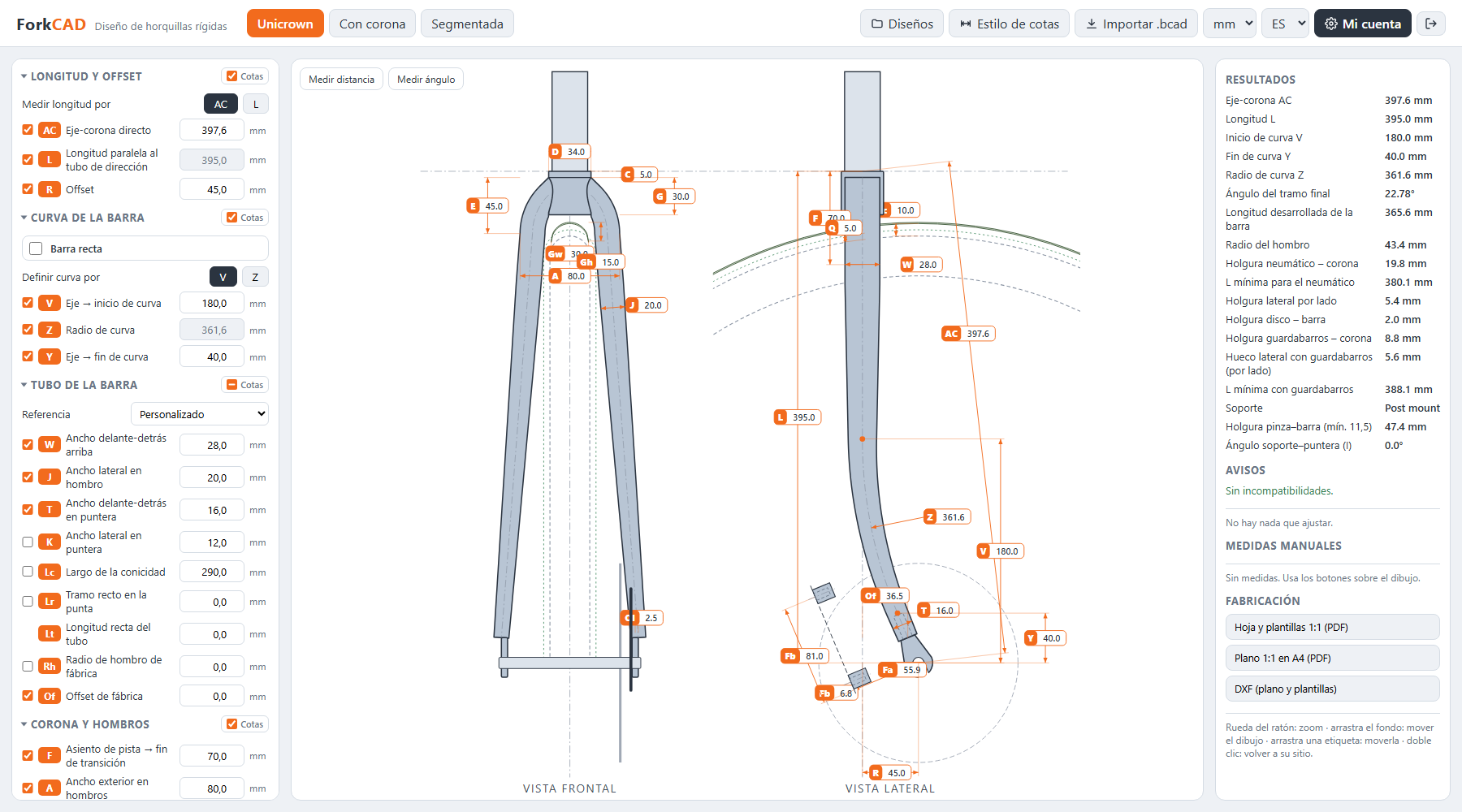
In ForkCAD you set "Measure length as" to "Axle-to-crown (direct)" (or "Length parallel to steerer"), enter the corrected value and the "Offset", and the fork is drawn with the wheel, so you see the clearance under the crown straight away.
FAQ
What does suspension corrected mean?
A rigid fork with the axle-to-crown of a suspension fork already compressed by its sag, so the frame keeps the geometry it was designed with.
How much sag should I subtract?
Among the builders cited, the figure that comes up most is 20% of the travel; some use 25% or 30%. It is not a standard.
What axle-to-crown does a rigid fork for a 100 mm frame need?
That of the specific 100 mm fork, minus the sag. At 20%, about 20 mm less than its published axle-to-crown. Do not use a generic figure: even 100 mm forks from the same brand vary.
Should I keep the same offset?
Yes, if you want the same steering as with the suspension fork at sag. Changing the offset changes the trail.
Sources
- Velocipede Salon: "Fork Length" or "Fork Length Minus Sag" (2013). Designing around the sagged fork, 20% as the usual figure, and axle-to-crown variation across 100 mm forks.
- BikeForums, Framebuilders: "Unicrown legs: splay angle for 29er". Warning about a suspension-corrected unicrown on a 29er.
- Wikipedia: Bicycle and motorcycle geometry. Effect of a longer fork on head angle and trail.